

An innovative project to revolutionise decommissioning work across the world – designed and built in Cumbria – has taken a major step forward.
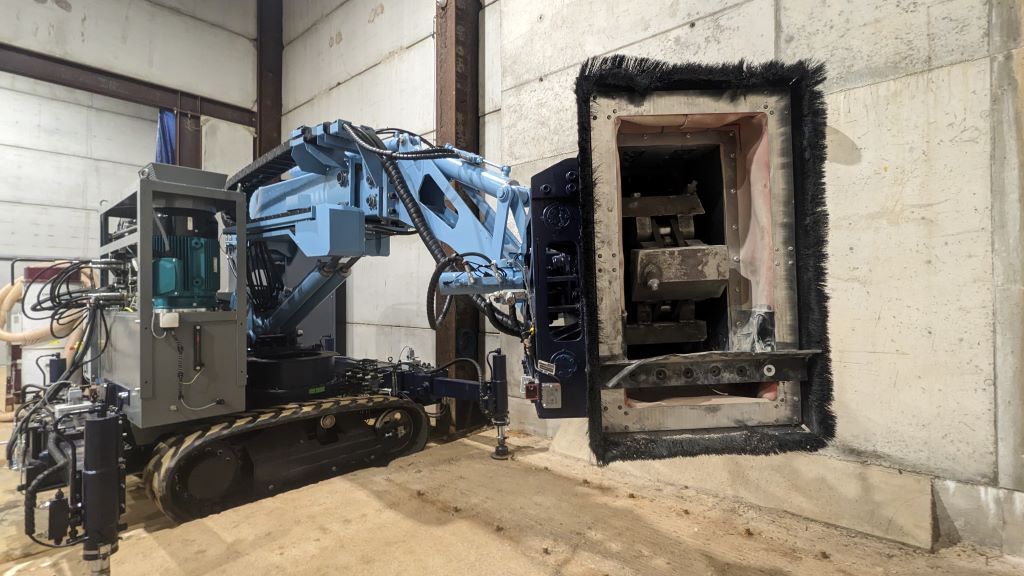
The Scabbler system, a remotely operated hydraulically-powered machine, has been demonstrated for the first time at Barrnon Ltd at its Appleby facility.
Experts took the firm’s experience in dry waste retrieval and reimagined it to safely remove contaminated concrete from nuclear facilities.
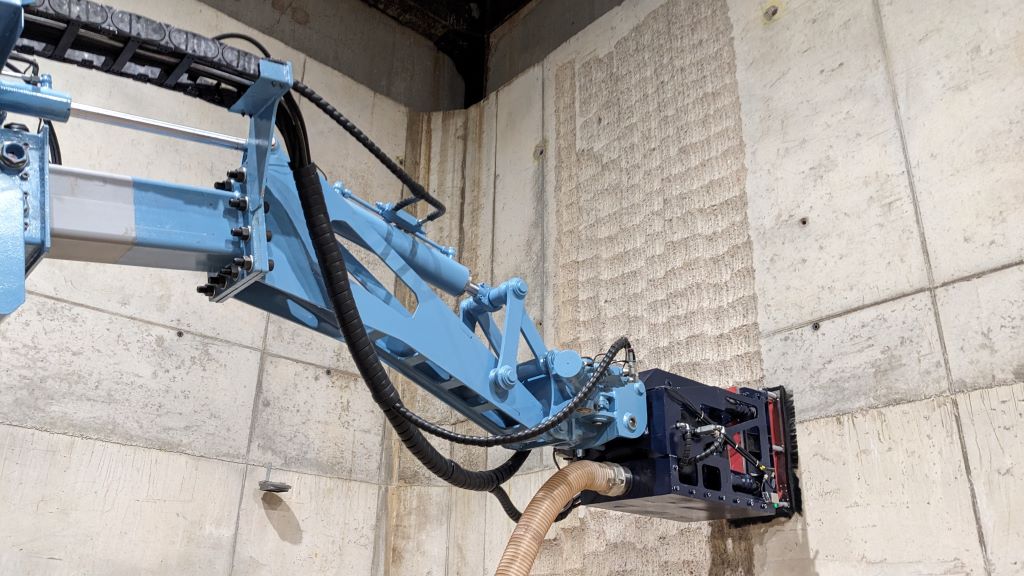
George Sewell, CTO of Barrnon Ltd, said: “Traditional scabbling machines used in demolition are effective at breaking up concrete, but create a large amount of dust and debris that can contaminate other areas and waste that requires secondary handling.
“Barrnon’s innovation was to develop a sprung shroud system that contains the waste created at the cutting head and uses a high powered vacuum recovery unit to carry the dust and debris away directly in to a waste container for disposal.
“The machine also utilises Barrnon’s robotics and ROV know how to improve the efficiency and user operation allowing automated cutting sequences and fully remote control to keep operators safe and away from the hazardous environments.”
The machine was designed and built by Barrnon, with funding from the Game Changers Innovation Programme, the Nuclear Decommissioning Authority and NRS Dounreay.
Scabbler is set to be delivered to the Dounreay nuclear site by the end of this year.
It will be tested there and Barrnon said it hoped that will inform future use of the innovative technology across the UK and the rest of the world.
Barrnon began work on the game-changing project three years ago and Scabbler was designed, built and tested in-house in Appleby.
George, who led the development of the Scabbler, added: “This has been a really great project both for Barrnon and the UK nuclear decommissioning industry as a whole.
“We have really shown how it is possible to take a large and complex piece of equipment from early stage concept through to a deployable machine that really solves a problem, and should allow safer and more efficient clean-up on nuclear sites.”
FIS360, which developed and co-delivers the Game Changers Innovation Programme, said: “This is a prime example of UK engineering ingenuity – driven by collaboration, shaped by stakeholder input, and guided by real-world testing and learning.”