



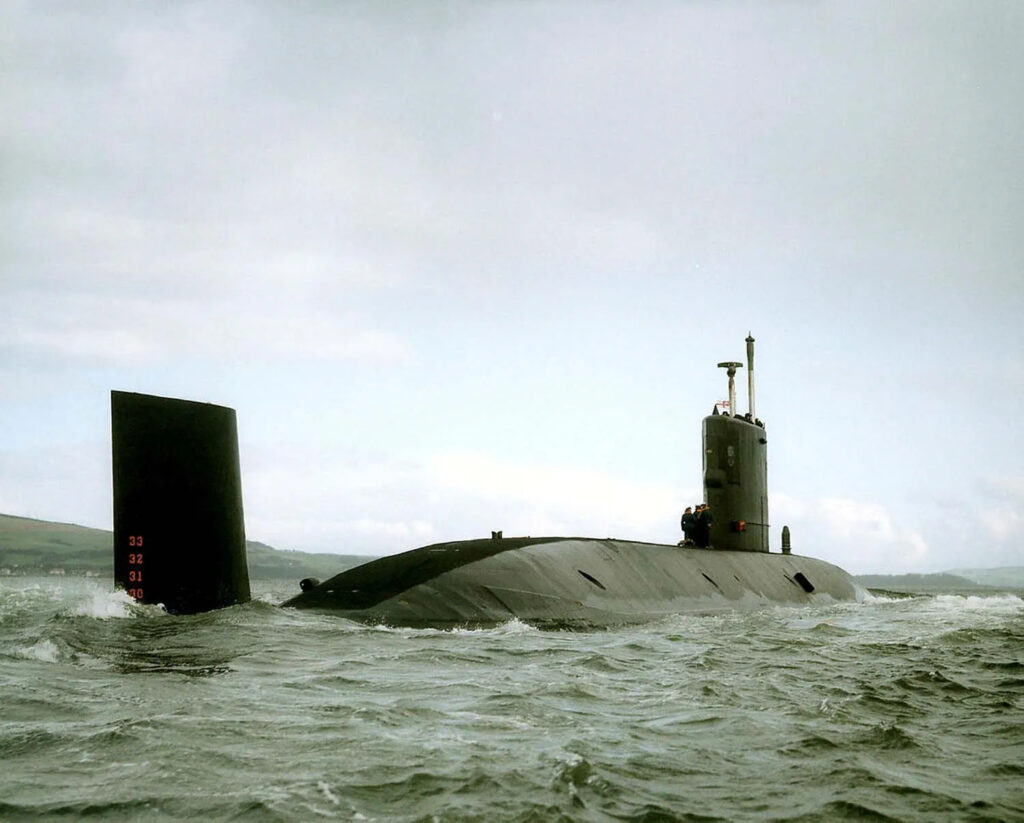
When she was launched in 1971 HMS Swiftsure represented the cutting edge of the Royal Navy’s Submarine Service. Now the Cold War veteran will serve as the blueprint for dismantling the rest of the UK’s decommissioned nuclear boats.
Swiftsure was withdrawn from service in 1992 after a career which saw crew take part in some of the most audacious actions of the Cold War.
“I wonder how many memories have been recalled: operations under the ice, crossings of the Equator, activities in each of the globe’s oceans, whether rolling uncomfortably at 400m, or drifting tensely in the adversaries’ baffles,” Chris Carpenter, head of submarine disposal and Devonport Infrastructure, told former crew members who came to see the submarine which is now housed in a dry dock at the Babcock facility at Rosyth.
“Whether you served on the longest continuous surveillance operation, or on the well-publicised Kiev recordings, I see your pride today. Your nerve, skill and determination set examples for us as valid today as they were then.”

The Kiev recordings capturing the sound signature of the flagship of the Red Fleet with the submarine’s periscope just 10ft below the aircraft carrier’s keel is one of the few publicised highlights of Swiftsure’s 19-year career.
With the reactor and fuel long since removed as well as any sections containing low-level radioactive waste, Rear Admiral JJ Bailey, director submarine support, said the main task of dismantling the boat could begin.
“More than 90% will be recycled and the project paves the way for the recycling of other laid up submarines,” Rear Admiral Bailey said. “The lessons learned from Swiftsure will be applied to the remaining laid-up fleet, ensuring all future boats are safely and efficiently recycled with cost savings where possible applied.”
Some of the material (mostly metal) will be used on next-generation submarines, such as the Dreadnought class currently under construction in Barrow and the future AUKUS boats. The rest will undergo conventional recycling. Dismantling Swiftsure is due to be completed by the end of 2026.
She is one of more than 20 decommissioned nuclear boats – mostly hunter-killers, but also all four first-generation deterrent submarines which paid off in the 1990s – awaiting recycling either in Rosyth or Devonport under the MOD’s complex, multi-phase Submarine Dismantling Project.