

Half term week and visitors are a welcome sight to businesses across the Lake District as February marks the traditional start of another tourist season.
But could this be one of the final February breaks before the introduction of new measures to raise money from some of the 41 million visitors coming to Cumbria?
In November, Friends of the Lake District published the results of a report researched over 12 months to suggest ways the area could benefit from a fresh approach to raising money to look after the area.
A tourist tax was one suggestion made by the campaign group which says it hopes to start a debate about the way the Lake District is funded.
Three months on, Business Crack has been gauging reaction to the study and asking what happens now.
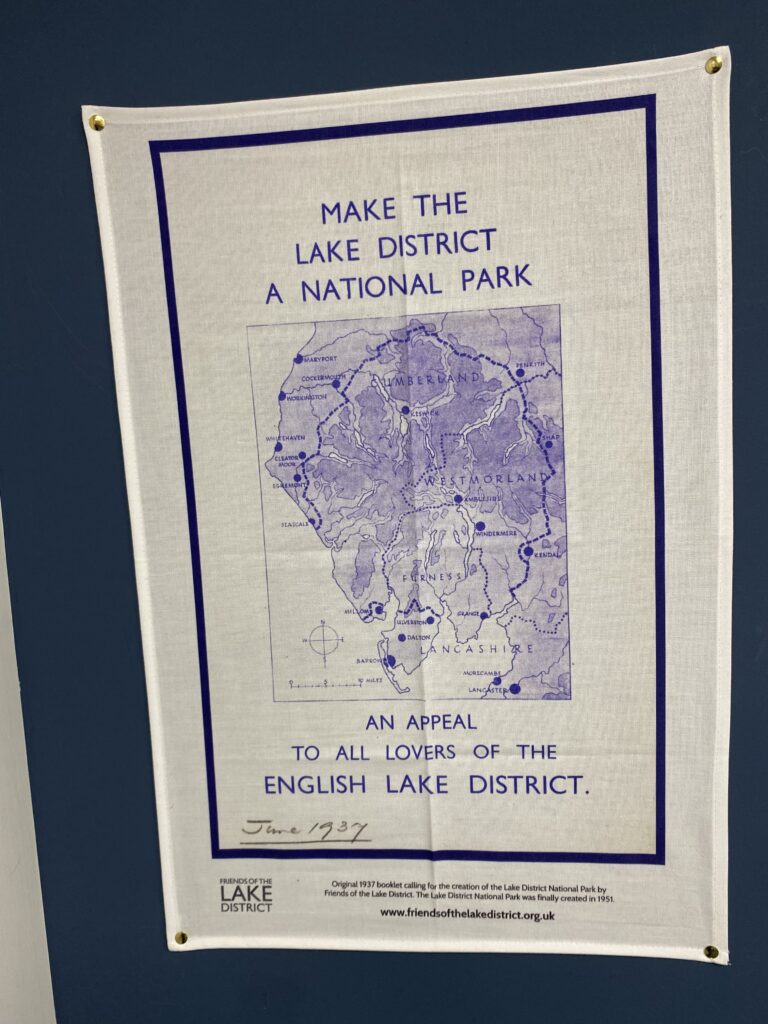
On the wall of Michael Hill’s office is a reproduced image of the booklet dating from 1937 urging ‘all lovers of the English Lake District’ to make the area a national park.
Friends of the Lake District took a lead in successfully lobbying for the status and 88 years on, Michael, the chief executive of the charity, is at pains to highlight the aims and ambition of the organisation.
“Campaigning is in our blood,” he says.

The charity’s report, Who Pays for the Lake District? was produced by Dr Davina Stanford, a sustainable tourism expert.
It highlights how tourism is creating an invisible burden on the Lake District National Park’s landscape, environment and communities. It also raises the issue of hollowing out communities, through the growth in second homes, and well publicised pressures on sewage systems.
In total, seven areas affected by tourism – transport, social capital, natural capital, energy use, water, solid waste and sewage – were examined by Dr Stanford.
“We wanted to bring a fresh angle to the debate and use storytelling to highlight external examples stimulating and triggering inspiration,” Michael says.
Tourist taxes
The issues caused by largescale tourism are not unique to the UK. The charity looked across Europe to find examples there where action has been taken to protect the very thing tourists want to see without pricing them out.
Venice began charging a 5 euro entry fee last spring aimed at encouraging tourists to plan their visits around quieter times.
It’s reported at the end of a test phase around £2m had been raised with the money earmarked for cleaning the city.
Another example quoted in the report was Île de Ré an island off the west coast of France. Linked to the mainland by a road bridge a fee of 8-16 Euros is charged. Lonely Planet says “This fee goes towards preserving the island’s nature and funding fantastic projects like the free shuttle buses.”
Elsewhere, not included in the report, Amsterdam (according to Lonely Planet) now has the highest tourist tax in Europe – 12.5% on hotel rooms.
The Dutch capital’s tourism policy concludes: “Residents, entrepreneurs and visitors are not at odds with each other. The city is for everyone. And together we are responsible for the city as a whole.”
Closer to home, ways of raising money to help areas that are popular with tourists are in place or being considered.
Edinburgh councillors have agreed to a tourist tax which will come into effect on July 24 2026. People booking accommodation, from hotels and bed and breakfasts to self catering and properties let via Airbnb and similar websites will pay a 5% addition to the overall bill.
The council reckons on raising £50m which will be spent on cleaning streets, removing graffiti and better transport.
In Manchester, anyone staying in a city centre hotel is currently urged to pay £1 per night to fund the Accommodation Business Improvement District (ABID) organisation, which promotes Manchester as a destination, and cleans the streets around hotels.
And it’s not just cities where tourists could be asked to contribute.
In Wales, the government is proposing a levy to raise money to pay for ‘localised costs from hosting visitors and enable additional public investment in tourism related infrastructure’ which could be for maintaining paths, cleaning beaches, supporting visitor centres and promoting the Welsh heritage.
Nothing is happening overnight. The bill has been introduced to the Senedd and a decision about whether it will become law is expected in 2025.
If the bill does become law, local authorities will then be able to decide whether they want to introduce a levy in their local areas, after first consulting their local population and businesses. The earliest possible introduction for a visitor levy would be in 2027.
Tourist tax in Lake District
What about the Lake District? Has the Friends of the Lake District report stimulated the kind of debate that the author’s hoped it would?
Cumbria Tourism, the county’s Local Visitor Economy Partnership (LVEP) which represents 4,500 members declined an offer to talk more about the questions raised since the publication of the Friends of the Lake District’s report.
Instead we were referred to the group’s statement which highlights last year’s publication of the county’s Destination Management Plan.
The 102-page document, drawn up by the tourism group but with consultation from both local councils, the Lake District and Yorkshire Dales National Park Authorities and the former Cumbria Local Enterprise Partnership, ‘seeks to ensure a balance between the economic benefits from a successful visitor economy and the need to support the environment and communities in Cumbria.’
Would a tourist tax be welcome? Their statement would suggest not.
“The visitor economy – businesses and visitors – already contributes hugely, for example through both direct and indirect taxation, from business rates to VAT, car parking revenues, to charitable giving to organisations including: the Lake District Foundation, mountain rescue, Fix the Fells, Cumbria Community Foundation, Growing Well and more.
“Cumbria Tourism itself has just launched a fund providing grants to young people starting work in the sector. There is a broad commitment from the DMP partners to continuing to work together to develop such opportunities.
“Alongside there is an ask of Government to change rules regarding allocation of central government funding to local authorities – currently based on resident population numbers.
“Cumbria’s tourism industry is made up of lots of small locally owned businesses, providing significant employment and helping underpin many community services and facilities – the greatest beneficiary is the indirect supply chain servicing the visitor economy sector – and our schools, public transport, retail, food and drink, cultural, arts and leisure offer would be very different without it.
“Visitor numbers remain down compared to pre-Covid levels and costs continue to rise for businesses who cannot pass it all on to the customer.”
Could government hold the key to the kinds of changes the Friends of the Lake District set out?

Tim Farron, the Liberal Democrat MP for Westmorland and Lonsdale, certainly thinks so.
“Visitors’ wheels are contributing to the potholes in our roads but there’s next to nothing in the funding formula for the local authority – and it’s the same for the NHS and policing,” he says.
“As I see it, there are four options. Option 1 is the current one – do nothing, option 2 is an Edinburgh-style bed tax, option 3 is some kind of congestion charge and option 4 is a more accurate funding formula which reflects those who visit as well as those who live here. That would be the fairest and least controversial.
“When I speak to hoteliers they are overwhelmingly opposed to this (a tax) but do recognise it is an issue. The accommodation sector is only part of the hospitality industry so a bed tax would disproportionally tax a minority of the industry.”
Instead of the introduction of a blanket congestion charge, a short term solution to reducing congestion would be more park and ride sites but the MP is disappointed that this isn’t an option that is supported by the Lake District National Park Authority.
A plan for a site at Pooley Bridge was turned down last year and newly appointed LDNPA chief executive Gavin Capstick told Countrystride podcast this month that when it came to pressure on popular parts of the park the area should not look to ‘build our way out of them.’
Growing demand on Lake District
While the Treasury may well again be in the sights of the area’s MP, for members of the Lakes Parish Council a levy or tax is attractive.
The council covers an area of nearly 13,500 hectares of land, the largest of any parish in south Lakeland, serving Ambleside, the Langdales, Rydal, Grasmere and Troutbeck.
In a statement to Business Crack the parish council said: “Lakes Parish Council recognises the immense value that millions of visitors bring to our beautiful area each year.
“Tourism is the lifeblood of our local economy, supporting businesses, jobs, and community life. However, the reality is that the cost of maintaining essential infrastructure – such as roads, footpaths, public conveniences, and local services – falls largely on a small number of residents who contribute through council tax.
“At present, the funds raised locally are not sufficient to keep pace with the growing demands on our area, and we are seeing the impact of that strain.
“Many other popular tourist destinations around the world have successfully implemented a visitor levy or tourist tax, and we believe this is a viable option worth considering. Crucially, any such levy must be ring-fenced for local use, ensuring that the funds raised directly benefit the area and are not absorbed into central government.
“It is equally important to acknowledge the positive contributions that visitors make to our community, and we do not wish to deter anyone from enjoying the Lake District.
“As a national park, this is a landscape for everyone to experience and appreciate. The goal is not to create barriers but to ensure that we can sustain and protect this special place for generations to come.”
‘It’s a no-brainer’
Among those supporting the idea of introducing some kind of payback for the area from tourists is Cumbria Wildlife Trust.
‘A no-brainer’ is how chief executive Stephen Trotter views the case for introducing a visitor levy or payback scheme, something he says is overwhelming in the Lake District.
“Mass tourism is damaging the special place that visitors are coming to experience and enjoy – and there’s a market failure to meet the scale of the costs and impacts that local people and the natural environment are suffering,” Mr Trotter says. ”The situation is simply not sustainable and solutions are urgently needed.”
His views are echoed by a leading academic based in Cumbria who studies and has written extensively on the challenges faced by upland landscapes.
Emeritus Professor of science and environment at the University of Cumbria Lois Mansfield says provided people could see for themselves how their money is helping conserve the Lake District it would encourage them to keep coming.
“For the Lake District, generating income like this would benefit everyone through directed giving to sustainable transport schemes, enhanced biodiversity projects and climate change adaptation needs all over the Lake District,” Prof Mansfield says.
“If visitors could explicitly see that their bed tax was helping make the Lake District more resilient, I am certain they would pay and continue to visit, and local businesses would benefit.”
Elected mayor for Cumbria
Three months after the release of the report, behind the scenes, it may well have served to begin the kind of discussion the authors hoped. However another factor has emerged which may well accelerate the debate.
Earlier this month the Government announced Cumbria is one of six areas where an elected mayor could be in place. Their role may well help influence how issues such as transport are resolved.
At the moment a new five-year plan is being drawn up by members of the Lake District Partnership, a group made up of 20 organisations drawn from the public, private, community and voluntary sectors.

In a statement independent chair Dr Celia Caulcott says: “There are no current plans to implement a ‘tourist tax’, or any of the measures proposed in the Who pays for the Lake District? report.
“We recognise the need to secure new investment into the Lake District and Cumbria to support local communities, our infrastructure and to help move people around sustainably.
“One of our current approaches is to encourage voluntary visitor giving to the Lake District Foundation which helps fund projects which serve our natural environment, climate and people.
“Discussions on a series of significant subject matters affecting the Lake District are taking place with all partners as we begin to develop the Lake District Partnership Plan 2026-2031.
“Friends of the Lake District are a valued member of the Lake District National Park Partnership and we welcome their insight. Their views and the recommendations of this report are not, however, representative of the partnership as a whole.”
The question of Who Pays for the Lake District? remains unanswered.
“We are having a series of robust and respectful conversations with colleagues on the Partnership about the issues we raise in our report,” Michael Hill, chief executive of Friends of the Lake District, said.
“Several partner organisations are supportive of our call for innovative funding solutions to address the ‘invisible burdens’ of tourism. We will continue to work through the Partnership and other channels to explore these.”
One thing that all sides do seem to agree on is that doing nothing is not an option.