

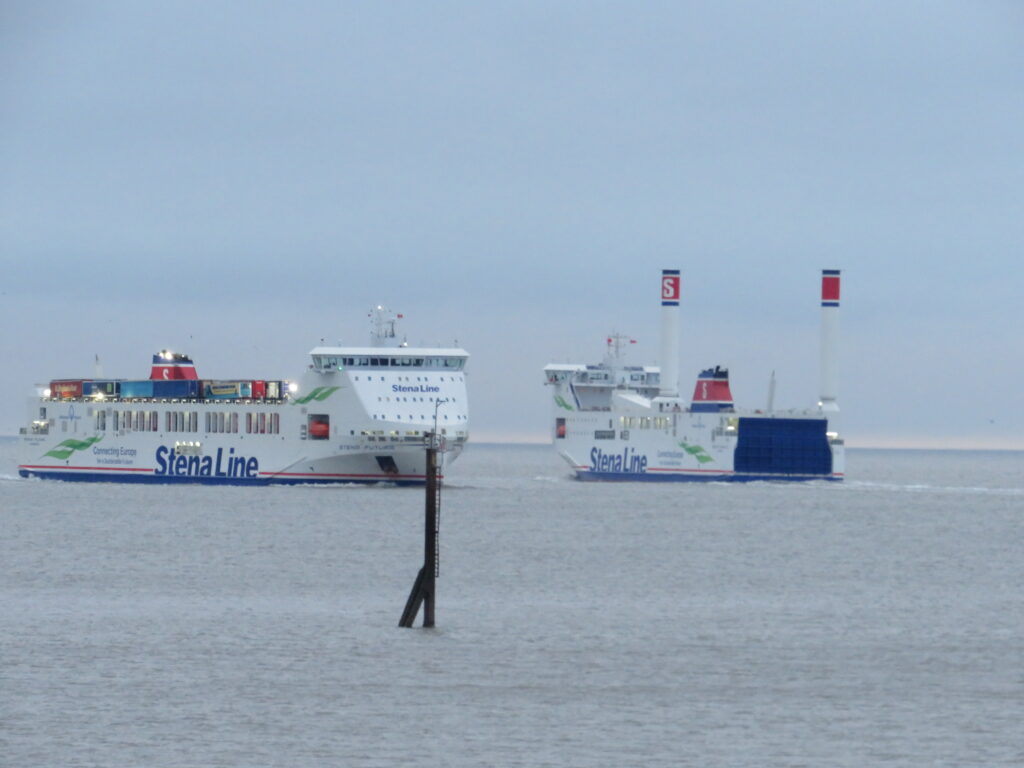
The distinctive profile of a new ferry which will be visible off the Cumbrian coast is apparent after the Stena Connecta made her maiden visit to Heysham port.
The latest purpose-built freight vessel commissioned by Stena Line for the Irish Sea is due to go into service on the Belfast-Heysham route from tomorrow, January 23.
The ship joins its sister vessel Stena Futura which went into service on the Belfast-Heysham service in October 2025.
Stena Connecta, like Stena Futura, is a so-called New Max RoRo ship built for maximised freight capacity, with 2,848 lane metres across its 147-metre length.
It uses a multi-hybrid propulsion system enabling the use of battery power, biofuel, and methanol.
Uniquely, Stena Connecta has two 28m x 4m Norsepower Rotor Sails, designed to enhance energy efficiency and could deliver up to 9% fuel savings on its Irish Sea route between Belfast and Heysham.
Stena Futura could also be fitted with rotor sails in the future.
“Our significant investment in Stena Connecta and Stena Futura – more than £100m – demonstrates our strong confidence in the continued growth of the Irish Sea region and our commitment to strengthening trade and connectivity links,” Paul Grant, Stena Line Irish Sea north trade director, said.
“In 2025 our Heysham – Belfast freight service recorded its highest volumes in the last 5 years with 113,000 units being shipped. These vessels were commissioned in response to this increasing customer demand for increased freight capacity on this route.”
The installation of wind power comes as efforts to decarbonise the maritime industry continue.
“Stena Connecta is a strong example of how forward-looking vessel design can combine operational efficiency with tangible emissions reductions,” Heikki Pöntynen, CEO of Norsepower, said.
“By integrating Norsepower Rotor Sails alongside hybrid propulsion and alternative fuel readiness, Stena Line is demonstrating a practical, data-driven approach to decarbonising short-sea shipping.
“We are proud to support Stena Line and Stena RoRo in bringing scalable wind propulsion into everyday commercial operation on the Irish Sea.’”