

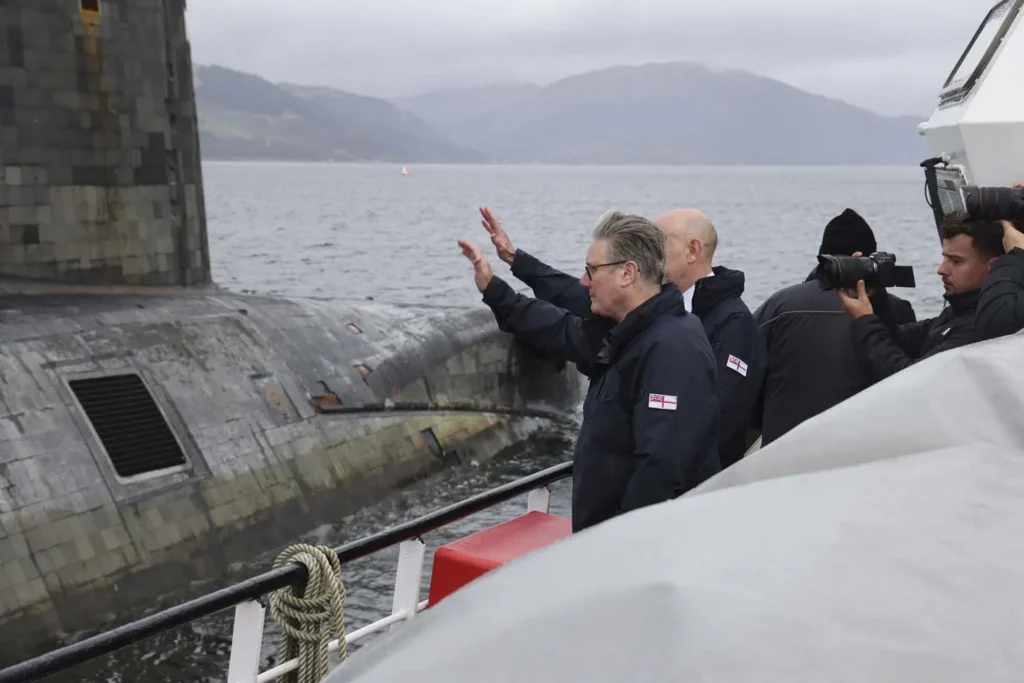
The crew of a Royal Navy Vanguard Class submarine have returned to HM Naval Base Clyde after spending a record-breaking time at sea.
The Barrow-built sub spent almost seven months at sea – 205 days in total – breaking the previous record for the longest unbroken patrol.
Among those joining the crew in the final part of their homeward journey was Prime Minister Sir Keir Starmer, Defence Secretary John Healey, First Sea Lord General Sir Gwyn Jenkins, and Chief of Defence Nuclear Madeline McTernan.
The UK’s Continuous At Sea Deterrent ensures that at least one nuclear-powered and armed ballistic missile submarine is always at sea to deter potential adversaries. The Prime Minister thanked the submariners for their dedication and commitment to defence.
Following his visit to the submarine at sea Sir Keir Starmer joined around 400 submariner families and loved ones within HM Naval Base Clyde’s Warrant Officers and Senior Rates Mess.
The Prime Minister’s visit came as the Submarine Service marked its 125th anniversary. Formed in 1901 with the arrival of the Royal Navy’s first submarine Holland 1, which was also built in Barrow, the service has earned a total of 14 Victoria Crosses, with five awarded during the First World War alone.
“The return from Continuous At-Sea Deterrence patrol is a moment to reflect with pride on the extraordinary dedication of the crew,” General Sir Gwyn Jenkins, First Sea Lord, said. “These highly trained submariners have once again demonstrated the professionalism and resolve that makes the Royal Navy the finest in the world.”
He added: “But the strength of our deterrent does not rest with the crew alone.
“Behind every sailor and submariner is a network of family and friends whose unwavering support makes these long deployments possible. Their sacrifice is quiet, but it is profound, and it is every bit as vital to the security of the United Kingdom as the work carried out beneath the waves.”
A new class of ballistic missile submarine – the Dreadnought Class – is currently under construction at Barrow and is expected to replace the Vanguard submarines from the early 2030s.
The Government is investing millions of pounds at HM Naval Base Clyde to prepare for the Dreadnought submarines.
Last year, the Government approved a £270M investment package – an initial three-year funding that will be used to adapt and improve infrastructure at the Clyde base.
The new Trident Training Facility Extension will provide crews, and in particular weapons engineers, with bespoke training using shore-based equipment that exactly replicates that found on board a Dreadnought vessel. It is expected that it will open its doors to the first students later this year.