


What if airlines could almost guarantee when their flights were going to touch down, ending the frustration of being held in a holding pattern which do little to minimise carbon concern?
An air traffic consultant living in Cumbria has piloted a scheme which is now attracting interest and has also been shortlisted for a prestigious award.
John van Hoogstraten has over 35 years experience in air traffic management, and has written about the industry’s drive for on-time performance and how fragmented decision-making between airlines, airports, and air traffic controllers has thwarted this.
“One of the challenges airlines face is on-time performance. To make sure they reach their destination on time extended flying times have become a reality,” John told Business Crack.
One example he studied is the Dublin to Gatwick route which once operated in an hour but today is timed at one hour and 10 minutes.
“Descent and delay has become a factor which means airlines and their passengers face delays which have a knock on for the airport which has to hold the aircraft until it can land and then manage baggage delays once a flight is on the ground,” John said.
He is now promoting a new concept which would enable delays to be absorbed during the duration of the flight.
If a pilot can be given a more precise landing time slot then aircrew would be able to adjust their speed to arrive at the airport in time to land without the need to be put into a holding pattern.
John’s concept is known as AFOS – the Airline Flight Optimisation System.
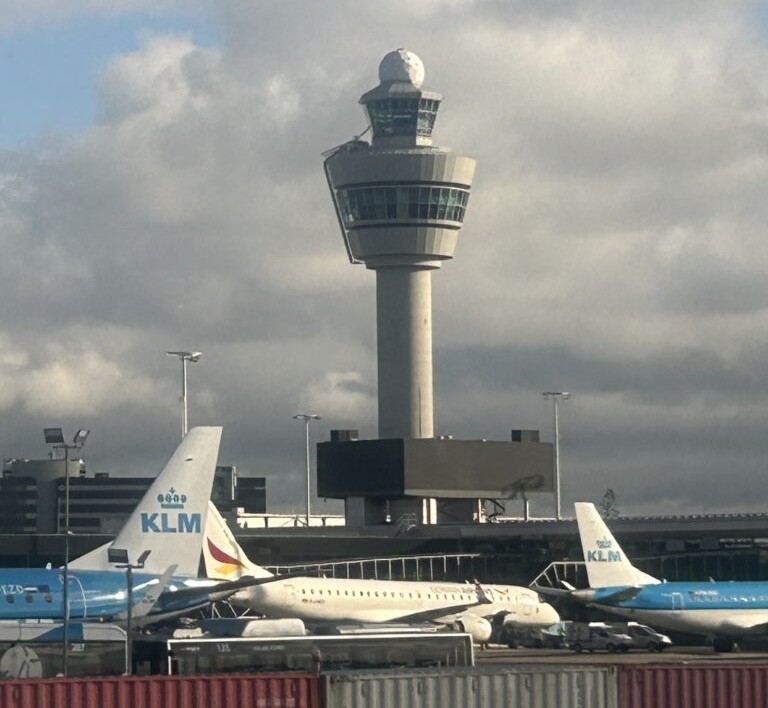
“The aim is to connect the airline’s intent with the network’s capacity.
“By integrating AFOS with Collaborative Decision-Making, Air Traffic Flow Management, and airport systems, the aviation ecosystem can shift from reaction to anticipation — improving efficiency, sustainability, and trust.”
So far one airline has tested the idea.
Aer Lingus assisted with proof of concept flights with 110 flights which resulted in just a fraction failing to land within 20 seconds of their allocated time.
“The idea comes from a military concept ‘time to target’ which we’ve adapted SmartSlot to be a smart slot to give aircrew time to adjust their speed to be sure of meeting a suggested time to start their approach,” John said.
The idea has attracted interest and has been shortlisted in the inaugural CANSO Seamless Skies Awards 2026 and is up against NASA, EUROCONTROL, and Germany’s national air navigation service provider, DFS Deutsche Flugsicherung.
The winners will be announced at Airspace World 2026 in Lisbon, Portugal, on May 26.
As well as saving time the concept could have a major impact on fuel consumption, something which may well focus more airline operators’ minds as recent events have led to fears of a shortage of jet fuel.
John said: “We’ve calculated that by using this system savings of around 30% could be achieved.”
He added that he hoped the award nomination would spark interest from others in an industry where innovative ideas such as this could improve passenger experience as well as airline economics.