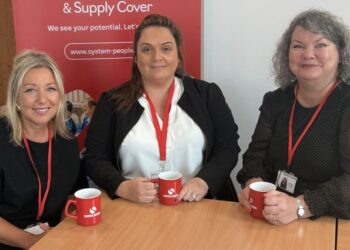


“Sometimes it’s down to us to ask ‘why are you doing that?’”
As chief technology officer for a company often asked to find a solution for a technical issue at the boundaries of what’s possible, Matt Mellor says his colleagues sometimes are able to solve it without the need for investment.
While the solution may mean the company doesn’t make a sale, it’s a measure of how Createc operates which maybe shows why it has once again received a prestigious Royal award – the King’s Award for innovation.
Matt Mellor spoke to Business Crack’s Nigel Thompson about the value of receiving the award and his views on how the world of tech is evolving.
I think the last time we spoke about a story on Business Crack, it was involving a robotic dog complete with legs which certainly caught my imagination!
That’s a good example. That robot is not our product that’s actually made by a US company called Boston Dynamics.
But what we do with that is to take that capability, the ability to walk, navigate difficult terrain, climb stairs, open doors, basically to get around and then turn that into something which has value for our customers.
So we give it skills like the ability to measure things, the ability to move things around to change things, to monitor things, and then to take appropriate actions.

For your customers as far as they’re concerned, are you kind of problem solvers? Do people come to you and say, ‘look, this is the issue, this is the challenge we’ve got. What have you got that you can help us with?’
Sometimes that’s the case or sometimes we’re actually observing our customers and realising where they would be able to get more.
I always say that the art of innovation is really asking the right question. And since we’re trying to be the innovators, we’d better be good at that!
So if our, if our clients can also be good at it, that’s fantastic. The dream is that somebody just comes to you with a brilliantly insightful question.
But sometimes it’s actually down to us to say, ‘well, you know, why are you doing that?’ Or ‘why wouldn’t you do it this way?’
And you find as soon as you find the right question, it sparks a sort of a chain reaction of further questions and answers and interactions that land you in a place of realising how things could be different.
That really is the moment in my mind that innovation happens.
But could it be the case that you talk yourself out of work because you suggest something and the client goes, ‘oh yeah, thank you very much. We’ll go away and do it ourselves!’ Does that happen?
Well, sometimes. It’s important to talk yourself out of the phantom of work. You don’t want to get a long way down the road with a customer and then realise that you shouldn’t really be doing what you’re doing.
We’re not looking to get paid for the work that we do on an hour-by-hour basis.

We really want to get paid for the value that we produce, and we want to do the most valuable things that we can possibly do with our time.
It’s really important to be focused on that question from the beginning.
And to ask the question ‘is there really some value here for us to add?’
Some of our customers find that a bit strange that they’ll come to us and they’ll say, ‘we want to buy one of these, or one of those’ and we’ll say, ‘are you sure?’
It’s very hard to ask the right question, but there are lots of wrong questions that you can learn to recognise.
Createc has received the King’s Award for innovation – what does it mean to you receiving something like that?
It does mean a lot in terms of, first of all, recognition for what we’re doing and it does also have an impact, I think, particularly with our international clients.
So people wouldn’t necessarily have heard of a British business award but they’ve all definitely heard of the King so they know that that must be a significant award.
Nobody’s going to make a decision to work with us off the back of that but it gives people a lot of confidence, I think, when we’re working in a place or with a group of people for the first time.
So it’s got practical value in that sense. But the other thing that I really appreciate about it is the fact that it measures what I think is actually important about a business.
So it is based on financial results, but financial results obtained in a certain way.
The two awards we have are for innovation and, international trade. For international trade you obtain that by growing significantly according to a reasonable definition of significant.
Then the innovation award and in particular, you have to be able to demonstrate that your innovation has recovered its costs and is now making money. And that is incredibly important to me and I think that is the definition of success.
How important is it to you that your company is making a difference, making the world a better place?
I think for me that’s just that, that’s one of the questions that’s just so fundamental. There’s no, there’s no answer to it really.
You’ve go to have some fundamental beliefs in life, and one of my fundamental beliefs is that you should put back more than you take out.
You yourself are the beneficiary of the start that society has given you by investing in itself and by the shoulders that you are standing on having elevated your start point.
So, to me, it’s incredibly important simply to be able to be positive in the future by believing that I and my colleagues and others and other similar businesses are striving to make the future a better place, which means more knowledge, more technologies, more capacities, more wealth- all of these things.
But when it comes to other people involved in technology who are seen as perhaps not engaged for ‘the right’ reasons, is there a danger that you are tarred with the same brush ie that people see you in the same light as other tech entrepreneurs?
I would be the first to criticise some of what we see going on in the tech landscape, but I do, despite all of that, believe that the vast majority of the individuals in it have the same motivation; that they believe they are making the world a better place.
I think that the thing, going back to the King’s Award that I like about this idea of actually measuring progress in terms of direct economic positivity, is that you don’t have to hope. You know, and it keeps you honest.
If you can say that people valued what I did for them or what we’ve done for them more than the people who sold me the materials and our employees’ time, all of that stuff was consumed was worth less than the stuff that we produced it’s a net gain.
It’s a net win for society as validated by people who aren’t in the business, by people outside of the business who have put that higher price tag on things.
So if we weren’t winning that game, we would be starved of resources and we would not be able to grow. So it really keeps you honest. I still believe that a huge proportion of the value that we all share in today has been produced by advances in science and technology.
And I believe that will continue into the future, but we seem to be in a period where there’s a rapid decline in the belief that that is what automatically happens.
But also I think a resignation to the idea that there’s an inevitability to that, that actually maybe technology has become a fundamentally regressive force that is trying to drag us in a direction we don’t want to go.
What do you mean by that? Because people might think there’s no such thing because technology by its nature is moving things on. But are you saying the way that technology is been used now or adapted, it can actually push people back?
Technology itself is not intrinsically good or bad; it’s something that we use and you can use it for good or bad.
And there certainly have been plenty of cases in the past where technology has resulted in short term bad outcomes, potentially even significant net negative short term outcomes.
But we’ve always overcome those. Everyone’s at least somewhat familiar with the challenges that the Industrial Revolution presented to society and then the massive reconfiguration of society and a lot of the negatives that went along with that.
But we’ve been able to push through those things and overcome them.
What history shows us is that we do overcome these things and that we will work out how to make the technology work for us and society will adapt.
So you’re still an optimist?
I’m a long term optimist!