

Is it possible to measure how quiet an area is and assess what impact development could have on it?
That’s the hope of work just released by the Friends of the Lake District with the aim of providing objective evidence to be considered by planning authorities.
The work was commissioned by the charity and conducted by Wild Land Research Limited and Lune Geographic who helped develop method for assessing and measuring tranquility levels across the Lake District.
“It’s something that’s important but very difficult to quantify,” Lorayne Wall, head of planning and policy at the Friends of the Lake District said.
“We felt it was wrong if this is something that’s so integral to the designation of what the national park was designated for and is all about, and it’s referenced in the local plan, in local planning policies and planning decisions, but there’s no way of quantifying it or measuring it or monitoring how it’s been impacted.
“So we really set out to try and put that right and fill that gap.”

While the need to be able to enjoy peace and quiet is often referenced when it comes to measuring health and well-being, it can be subjective; what one person may find quiet could still be too much for another.
The idea of mapping tranquil areas is not new.
In 2007 the Campaign for the Protection of Rural England produced a nationwide map and went on to lobby planning authorities as part of the Give Peace a Chance initiative.
Building on this the new work in the Lake District began by mapping existing developments – roads, built-up areas – that are known to have a negative effect for most people.
Surveyors also mapped areas known to have a mostly positive effect, such as water, open views and woodland.
By using a similar methodology to the CPRE the impact each factor had was assessed and assigned a colour to the figure generated.
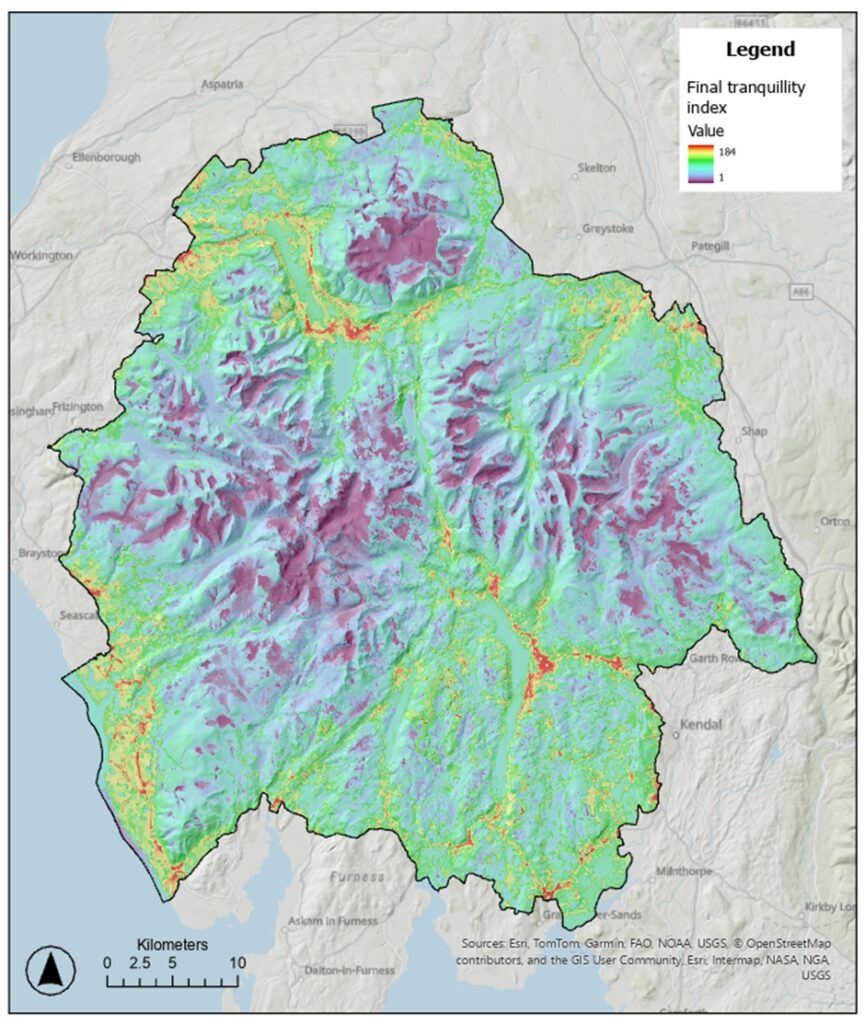
“We’ve added a layer of qualitative information as well of what people’s perceptions were of tranquility in those locations as well,” Lorayne said.
“There were some concerns, even in the responses to the survey itself, that they were afraid that by telling everyone where was tranquil, that those tranquil areas would suddenly become popular. It’s all reinforcing what most people would probably already think.”
The aim is that the park authority and other public bodies such as Natural England, Environment Agency, United Utilities and councils will use the research when considering future planning applications through revised planning policies.
With work now underway on a new park management plan the hope is that this will be included in the long term vision for the Lake District.